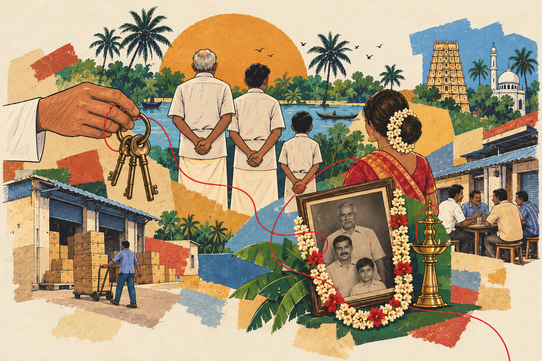
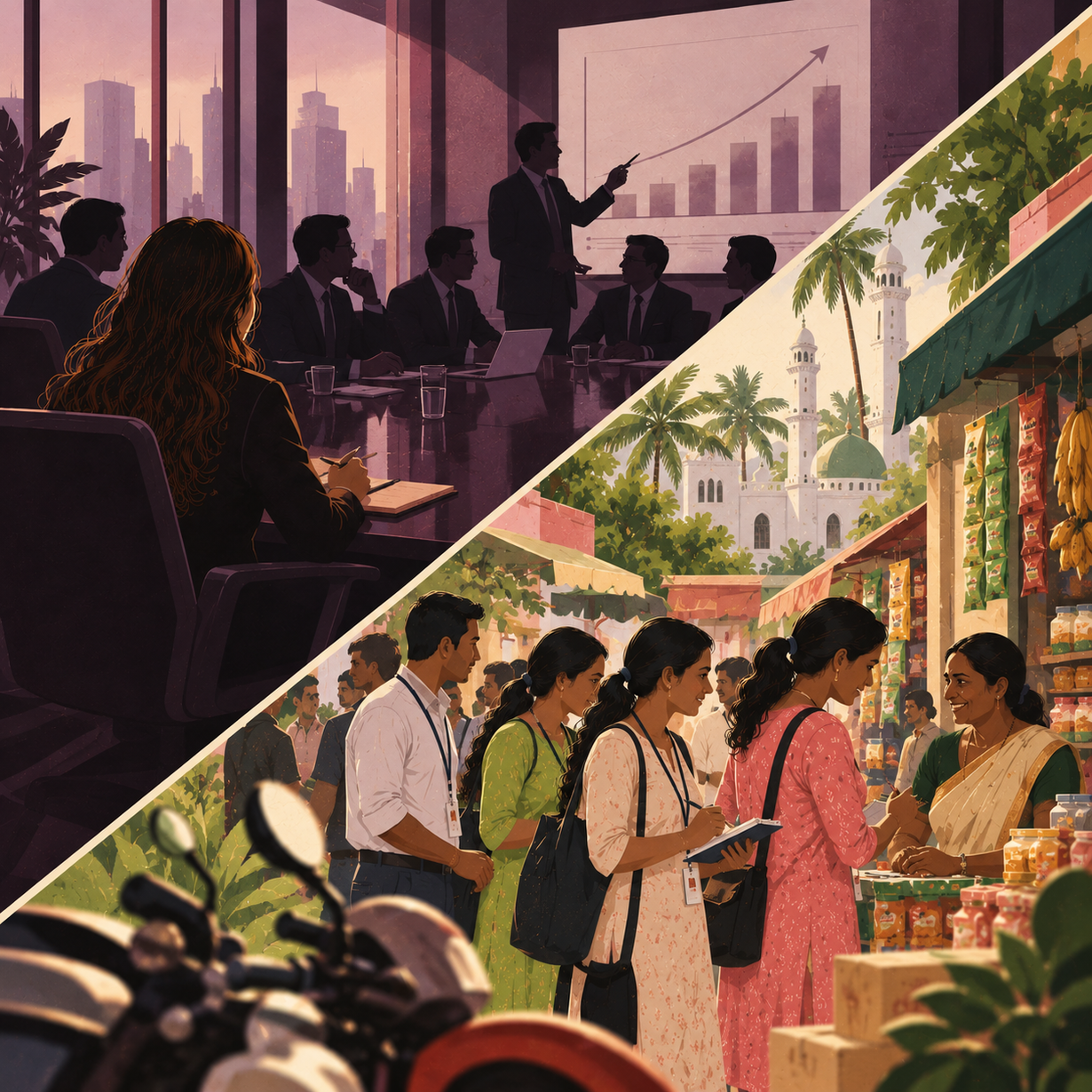
Every meeting room I sat in above the RS-point level, with my TSO, my KAE and my ASM, I was the only woman in it. Every single time. But the moment I stepped onto the field, that flipped almost entirely. Close to half the MEs on the beats I rode were women, and that contrast still sits oddly in my head. The higher up you went in that structure, the more it looked like every boardroom I’d ever pictured. The closer to the ground, the more it didn’t. And this was Kerala, the most literate state in the country, where practically everyone reads and writes.
Nobody had to tell anyone to look out for me, but they did anyway. Whenever I went out on a beat, I was paired with a female ME, not because I asked, but because it was just understood that I’d feel safer on her bike than a stranger’s. I didn’t clock it as anything unusual at first. It only hit me later how deliberate that quiet arrangement actually was.
And then there was the day I wore a t-shirt. Calicut is a conservative city: kurtis, nothing sleeveless, nothing that showed much at all, and every woman I worked alongside dressed accordingly, without exception. I hadn’t thought much of packing a t-shirt for a hot day until I actually wore it out into the market and felt, for the first time in two months, genuinely unsafe. Not threatened by any one person. Just aware, all at once, of every eye that lingered a second too long.
That contrast is the thing I keep turning over. Literacy can be close to universal, and women can make up half the workforce on the ground, and leadership can still be gendered. I didn’t find that in a dataset this time. I saw it on the field, in every room above the RS point where decisions were made. Education got women into the work. It hadn’t got them into the decisions. I was looked after in ways I never had to ask for, and still a t-shirt could make me feel unsafe on a street I walked every single day.
I’d seen this shape before, on paper. In high school, I wrote a paper on the feminisation of teaching in India, including my own survey of some 200 students, teachers and professors. Women make up a huge share of teachers, but they’re sequestered in the lower grades, where teaching is treated as an extension of mothering, and in “feminine” subjects like languages rather than the hard sciences. They’re rarely in the administrative roles that run the very profession they dominate. A headline proportion can hide where the power actually sits. Literacy isn’t empowerment. I don’t think I truly understood that distinction until I lived inside it.